Lisa Gottfried: New Tech High
  • Blog
    • Nature Journal
  • About Me
    • Resume
    • Recommendations
  • In the News
    • Awards
  • Contact
  • Blog
    • Nature Journal
  • About Me
    • Resume
    • Recommendations
  • In the News
    • Awards
  • Contact

BLOG

Being in Service

2/4/2020

0 Comments

 
Picture
Over the years I've volunteered in many different capacities.  I've served on boards, cleaned kitty litter, restored bee boxes, taught children English, pulled weeds, and brought juice boxes and goldfish fo snacking  toddlers. In all of those endeavors, I've become a better person because of my efforts.  But, even to make this statement seems selfish.  Mostly, it's just a nice thing to know that in some small way, that I've made the world a better place.  Other things that are an extra-added benefit are that I gain experience, leadership skills, empathy and compassion for others, as well as meeting some really amazing people who I would not have ordinarily met. Being in service is a powerful thing, and I hope to do much more of that in the future.
0 Comments

How We Turned a Huge Failed Project into a Major Success

1/9/2019

0 Comments

 
 Last year, we teamed up with the Napa Parks and Recreation Department to create Countdown Clocks for the first ever Napa Lighted Art Festival.  The Game Design class experimented with the idea of what a clock is and is not and how to incorporate ideas of time in different ways using Illustrator and After Effects.  The video below is a sped up version of each clock.  They were supposed to be projected on several buildings downtown in between the light shows in 20-minute increments.  The finished work never got used and the students were disappointed.  But that's not the end of the story.
There were many contributing factors to the failure.  This was the first year of the festival and we didn't know what we didn't know.  We also encountered pretty devastating fires in the Napa Valley and sponsors were not able to recover from the financial loss from lost tourism and pulled out of their sponsorships.  Time was not on our side either, as we were working under very short deadlines. 

Regardless of whether our work was shown, the students made some really cool artwork and learned some great technical skills along the way, so it was not a complete failure, but we were a bit disappointed. Luckily, we were willing to try again.

I decided to reach out to the Parks and Rec department to see if we could try our collaboration again.  Yes! They were interested and big changes were already in the works to hire a community liaison for schools in the district, to  hire consultants from the UK, Ross Ashton and Karin Monid from The Projection Studio, and we had a lot more time to plan properly and find new sponsors for the students to have their own building.   We decided to give it another go.  
 
I'm so glad we stuck with the project and tried again because the extent of learning and the scope of what we accomplished this year really blew me and the students away!

See the New Tech Lighted Art Project below!

This year the project entailed students creating their own six-minute show by working in 4 teams to create a cohesive, yet varied art exhibit.  The work was then projected on a 70 ft wall on the Native Sons Hall during the Napa Lighted Art Festival, January 12-20, 2019.  Our show has gotten nothing by praise from audience goers and there is just nothing like seeing student work projected on a building of that magnitude to a live audience of thousands.  The stakes were high and the students came through.  There were many sleepless nights when I wondered if they were going to make it, but they did and did so in an incredibly professional manner. I am so proud!

Community Discussion Panel:
​Hear what the students had to say about their learning

A Create-a-thon in the middle of it all!

As a part of the sponsorship agreement with Adobe, we offered to run a day-long school-wide design day, using Adobe Software. The top creators of the Create-a-thon were given the opportunity to have their work included at the end of our Lighted Art Project.   If you want to know more about the Create-a-thon specifically, you can find the blog post HERE.  

So, my students were tasked with both putting on a major event for 650 students in early January, as well as creating their Light Show art piece. These two tasks took up our entire Fall semester. 

Our Step-by-Step process

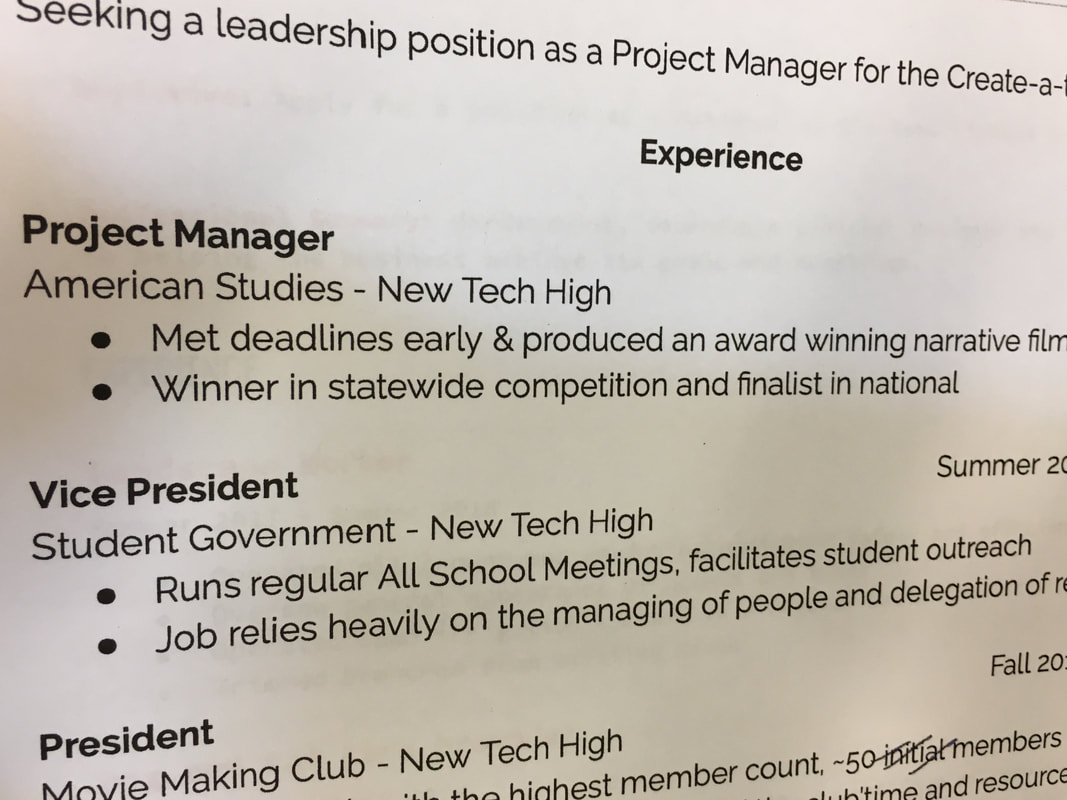
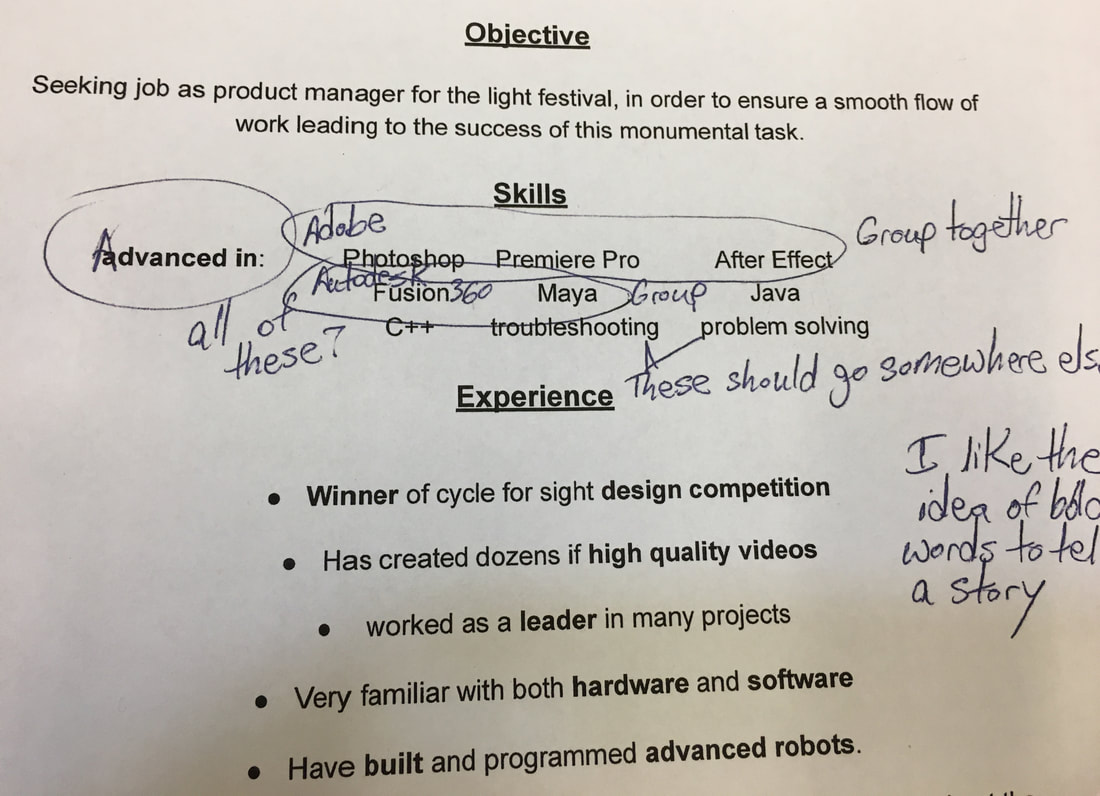
At the beginning of the semester students interviewed for a variety of jobs on each team, Project Managers, Technical Experts, Designers and Documentarians. They submitted resumes for the job and had to do a presentation of a SWOT analysis of themselves as hirable people.

Picture
Picture
Ideation phase: Students met in their hired teams and ran through the ideation and prototyping phases.  Then pitched their ideas to the entire group with a visual presentation.
​
They met with Ross Ashton and Karin Monid from London via skype to discuss Knows and Need to Knows.  Ross presented some basic concepts they needed to keep in mind when they created their artwork, such as taking into account the scale of the building, the ambient light and technical issues. 
Iteration was key in this project as students worked through their prototypes, gave each other feedback and got feedback from their mentors. Through all of the process, students ran the decision making meetings and took leadership roles within the class and within their smaller teams.
Students met in Scrum meetings or "stand-up" meetings at the beginning of every class to see what had been done, what still needed to be done, who would do the tasks and when they would be complete. They used the Agile Project Management protocol to manage time, resources and people.

Celebrating our final product!

Having a chance to look back on this project, I don't know how we pulled off such a thing!  The students owned this from beginning to end and benefitted from being given such an adult project to complete.  They had the skill and know-how.  The feedback we have gotten from the show has been amazing.  Many people commented that the New Tech piece was their favorite.  It certainly held the audience's attention and entertained in a way that was both exciting and fresh.  I am already planning for how we can do this again next year.  Look out Napa Lighted Art Festival 2020!
0 Comments

Poetry and Claymation: How Odd Pairings Aide Learning

7/14/2017

1 Comment

 
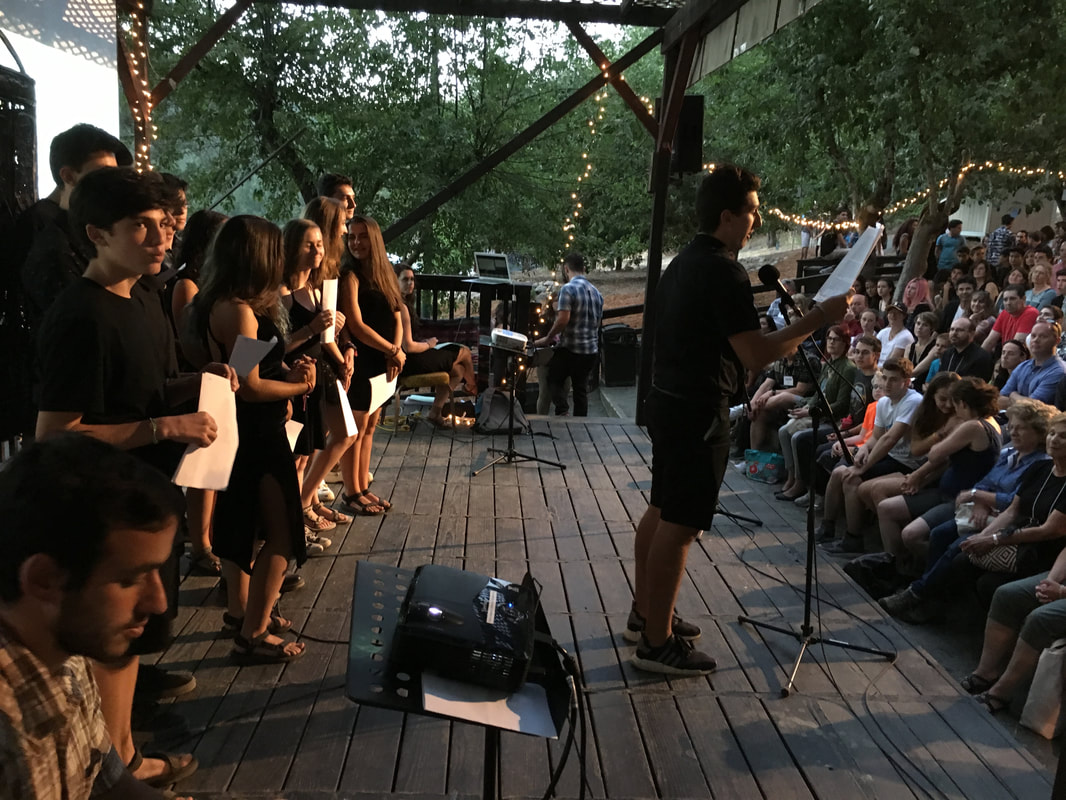
PictureCampers read their poetry and show their claymation to parents and friends
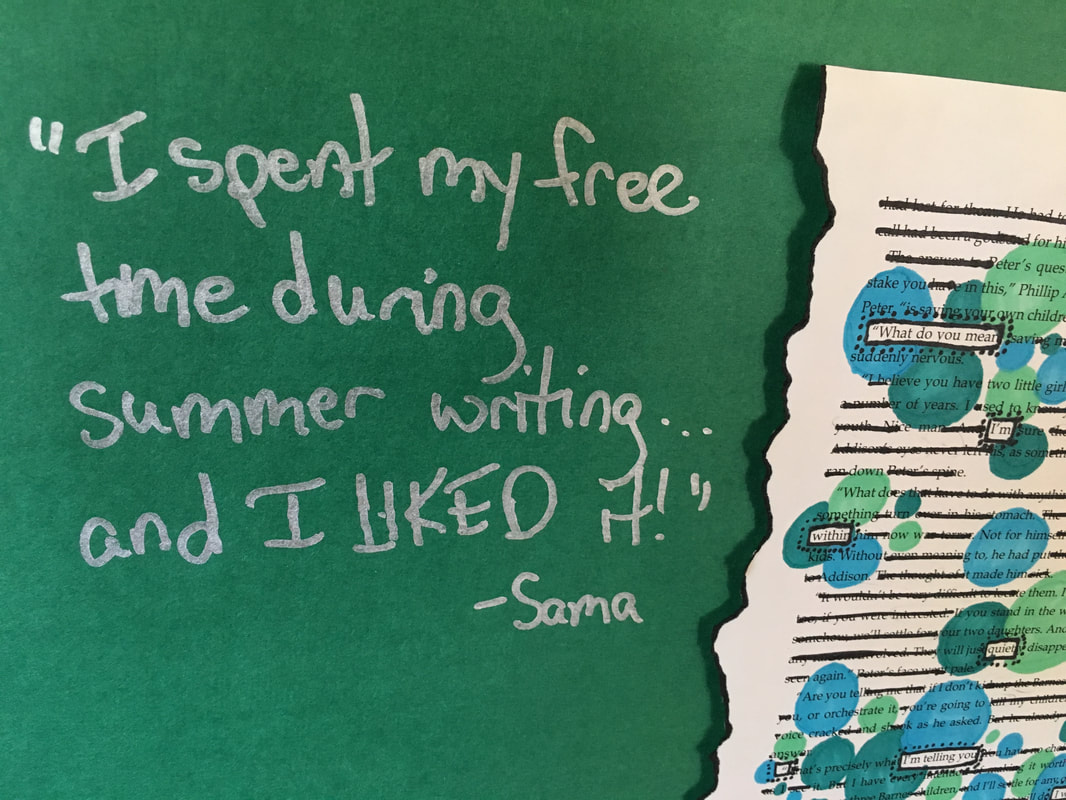
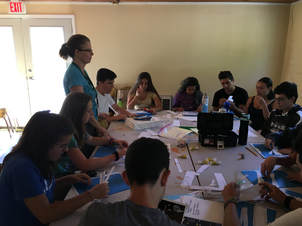
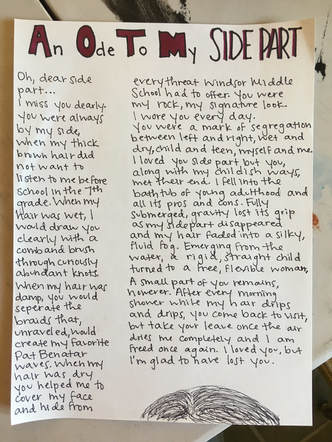
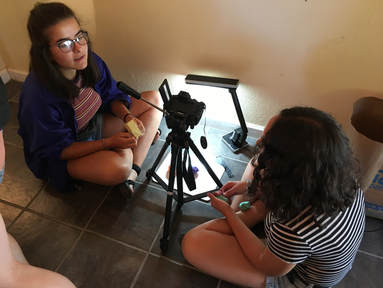
 For the fourth year in a row, I have spent part of my summer teaching high school students up at Camp Newman in Northern California.  In the past, I have concentrated on teaching video storytelling in the Arts-based camp session and also in the Social Action-based camp session, alternating between the two.  This summer I decided that I wanted to bring something different to the campers, something that would marry head, heart and hands together to engage the whole camper.  So I decided to enlist my friend Hillary Homzie to help me create a new class called "Poetry and Claymation"  You can read all about what we did in the article "Fearless Campers Use Clay and Poetry to Express Emotions."

Both of us decided that it would be best to split the 90 minute sessions by using  the first half of each class to write poetry and the second half, working with clay and cameras.  Having this nice balance between head and hand-based work really worked for the campers.  
Picture
Picture
Mental Note to Self: When working with students, use two seemingly different activities happening at the same time to balance out left and right brain engagement.
Picture
 Campers were surprised at how two very different activities could complement each other so well.  They felt that when they could move freely between the two activities, depending upon their mood, or their process, it really helped to keep them engaged. Once we got them going with a few days of splitting the class in half, time-wise, we let them decide how they wanted to spend their time thereafter.  Some campers chose to spend 90 minutes one day focusing totally on claymation and then the next day, totally on poetry.  Other campers chose several days of just claymation and then poured out their poetry on the last day of class.  They seemed unsure at first about writing poetry, but seemed to grasp the concepts on their own time, and then, really surprised us at the end!

Picture
Natural Differentiation: Having two simultaneous and intertwined activities gave each learner the chance to engage in each activity when they were ready and at their own speed.  
 Even when we, as teachers, worried about a camper missing out on one activity, they all came through in the end because it was creative, it allowed them to find their own voice, and ultimately, they saw value in balanced end product.  It took trust on our part, as teachers to allow that unfold.  I will be taking this dual-activity concept into the school year next year, for sure.  I may even have to do this project with my Video Storytelling class.  It would be a great way to start the year off!
1 Comment

Authentic Learning Projects: Best Class/Community Partnership EVER!

7/15/2016

2 Comments

 
Picture
Picture
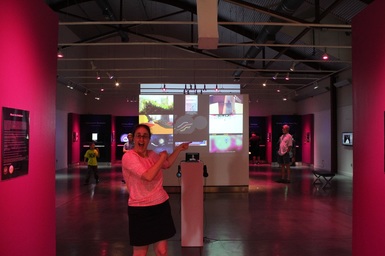
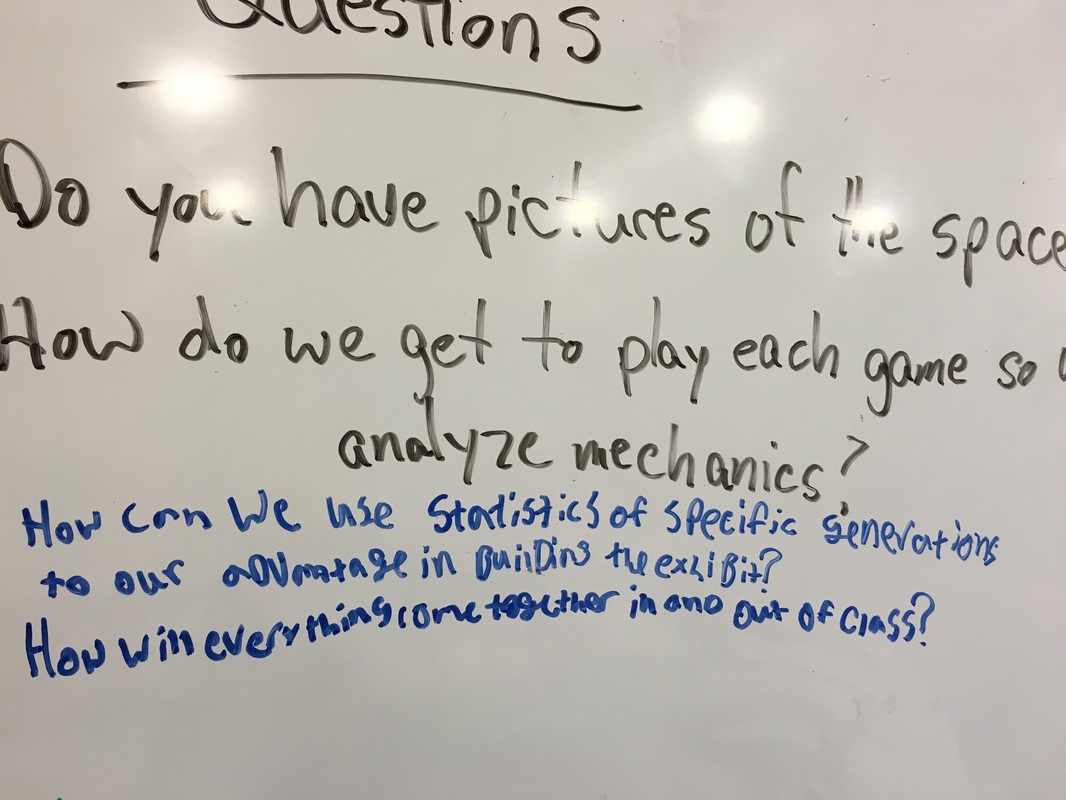
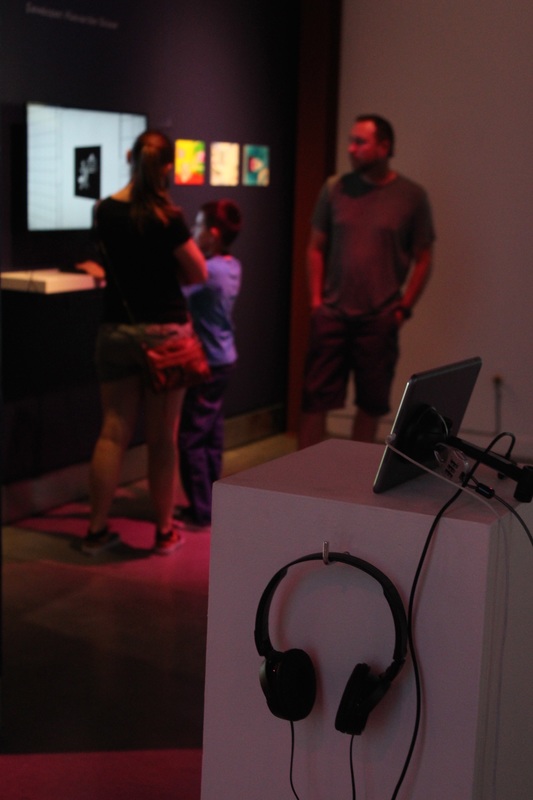
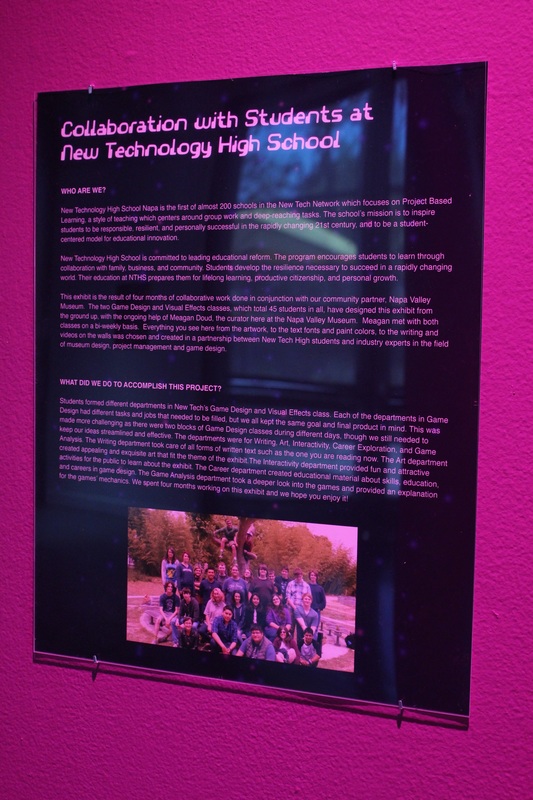
Today is the day that our final product from Game Design came to fruition.  I can't believe that this actually happened.  About six months ago, the curator from the Napa Valley Museum, Meagan Doud, called New Tech High, looking for interns to help with a future exhibit about Indie Games.  They sent the call to me, thank goodness!

At that time, I boldly suggested that instead of recruiting a few interns, why didn't we just have the two Game Design classes I teach take on the exhibit as a school project?  I had no idea how awesome it would be!

I took the idea to the students and asked permission to let go of the last project of the year, which was to center around coding and drones.  Some were reluctant, because, hey, who doesn't love tinkering with drones? But most saw it as an opportunity to do something real and substantial, related to the Game Industry, a field that about half of the 45 students were interested in entering upon graduation from high school, or college.  
Picture
Picture
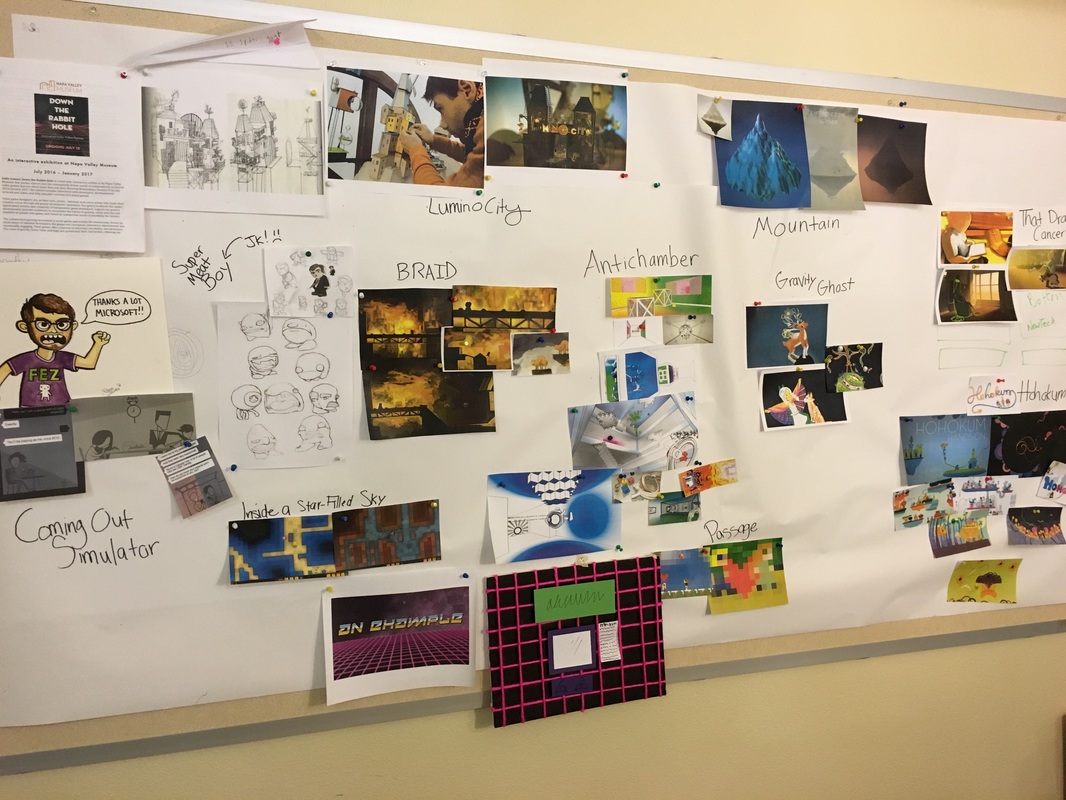
We split the teams up into different sections, some covering music, art, 3D  modeling, video, interactivity, early childhood educational components, game mechanics and game careers.  Students picked their own areas of interest and away we went.  We met with the curator every two weeks, either in person, or via Skype to review questions, status reports and next steps.  Two students, one from each class, came to me and asked if they could be the overall project managers. Could they essentially be in charge of the exhibit?  Um....yeah!  They happened to be two seniors, one who is pursuing Game Design in college next year, and one who wanted to try on the mantle of leadership. Every team also had team project managers (PMs), who were responsible for communicating with the other team PMs, the Lead PMs and with Meagan. There were several PM meetings outside of class to make sure that everyone was on the same page with the project. 
Picture
Picture
Picture
 Students were asked to consider several target audiences, ranging from families with small children up to attendees from the Veteran's home on the same campus as the museum.  Together, we learned about project management skills, from Gantt charts, to Scrum Meetings, to managing resources and deadlines, to using the Design Thinking Method to get clear about prototypes and deliverables.  This was a hefty, real world project.   It also turns out that we have a New Tech parent who designs exhibits for a living!  At the last moment, he jumped in to show off his own work and help the Game Design students really think deeply about how to best engage exhibit visitors.  

In addition, students learned about 3D modeling, motion graphics, 2D graphics, color theory, writing for signage and exhibits, research, game mechanics and game careers, prototyping, video filming and editing, presenting, and above all, collaboration.

I really do hope, that if you are in the area, that you stop by and see the exhibit.  It turned out better than I ever could have hoped and I am SO proud of the work that we ALL did together.  

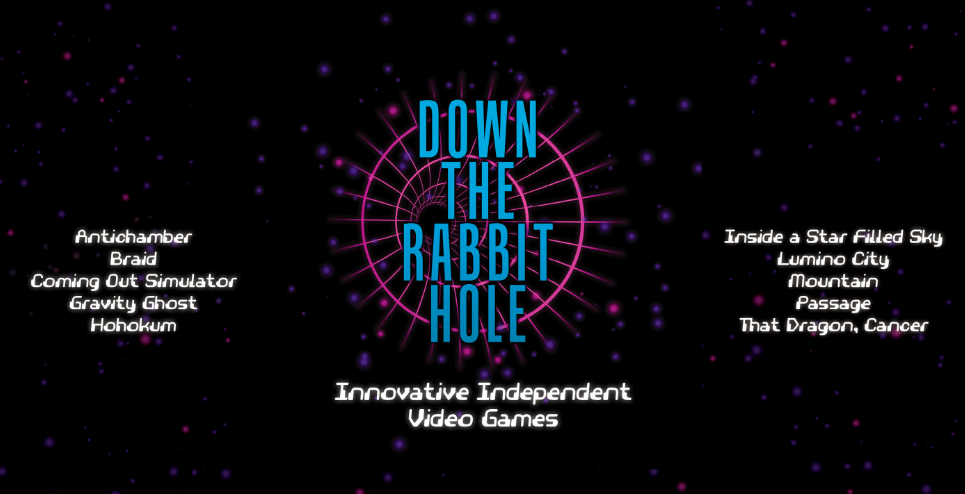
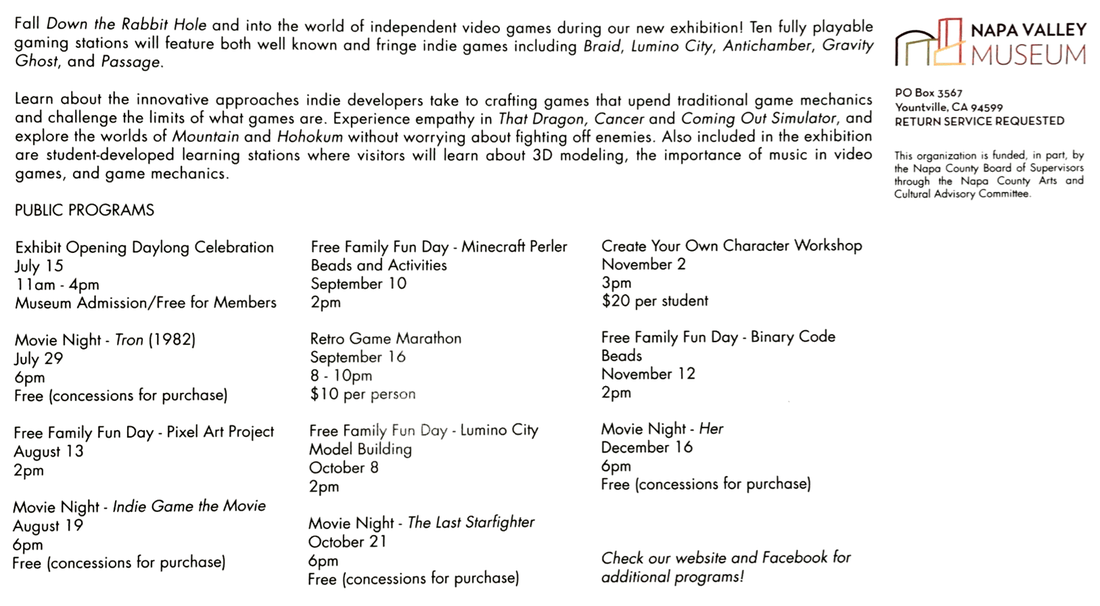
"Down the Rabbit Hole" runs from July 15, 2016 through January 8, 2017 at the Napa Valley Museum in Yountville, CA, in the Napa Valley and it features 10 Indie Games.  There are some great movie nights and Family Fun Days offered, including a Retro Game Marathon, Model Building, Learning about Binary Code and Pixel Art.  Look at the very bottom of the blog post for the info. on the show and activities.

For me, finding authentic learning projects is a personal passion, and I am convinced that they can not only be done, but done well, can give students real-world experience, and can provide the impetus for some amazing learning.  If you have questions for me about authentic learning projects, you can always contact me on twitter @lisagottfried or leave a comment on this post and I'll get back to you.
Picture
2 Comments

Another Take on "Need to Knows": Micro-Moment Timeline Interviews: 

6/13/2016

1 Comment

 
In a paper entitled "Qualitative Research in Information Management" Jack Glazier and Ronald Powell take a look at how humans process and use information and define the methodology, theory and body of findings as Sense-Making.  In chapter six of their paper, they look at the Sense-Making Qualitative and Quantitative Methodology from the Mind's Eye of the User.  They make the assumption that because humans are involved, there is a discontinuity in perception based on different conditions of the human depending on the time and space in which an event occurs. These differences come down to so many factors, cultural, physiological, almost any situational conditions. 

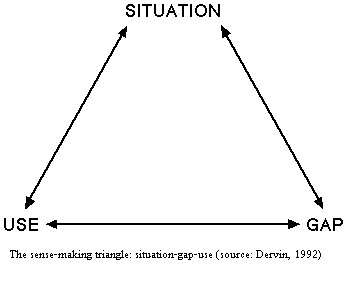
They describe a common problem with the way we have collected data in the past on how humans use information, in that the questions we ask come from a system standpoint, where the interviewee is asked questions that assume that they will bend to the will of the system, rather than the system changing to meet the needs of the interviewee.  In 6 step, they outline how one can change this approach to be more user centered by focusing on the  Situation/Gap/Help model.
Picture
Picture
The Situation/Gap/Help Model looks at the strategies used as well as the information values sought.  It also looks at the questions answered, ideas formed and resources obtained as a user bridges the gap of information.  It also reviews the blocks or barriers faced as one attempted to bridge a gap.
The study of information-needs places an emphasis on these 6 questions:
1) How does the individual see themselves as stopped?
2) What questions or confusions have been defined?
3) What strategies does the individual prefer for arriving at answers?
4) What success has this person had in arriving at answers?
5) How was he/she helped by answers or how did he/she put the answers to use?
6) What barriers did the individual see standing in the way to arrive at the answers?
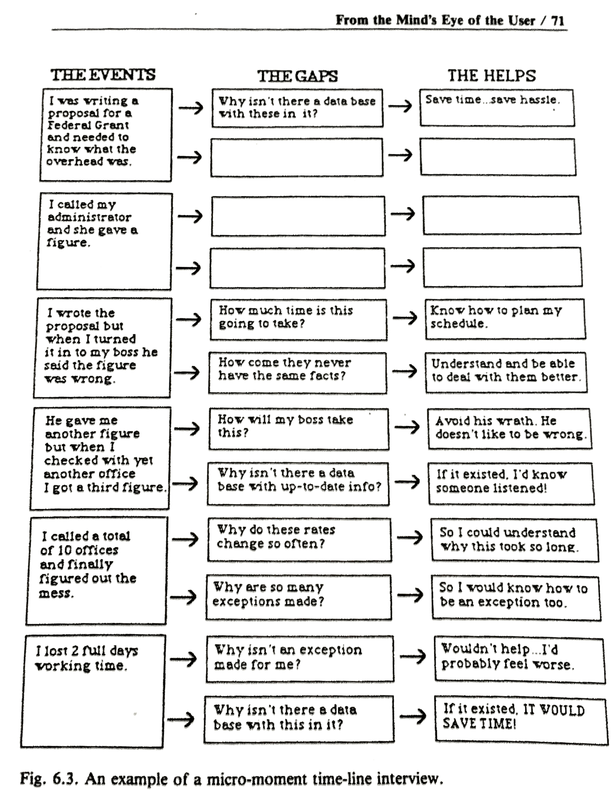
This could be a really powerful tool for my students when they are confronted with a gap in knowledge.  For those students who get "stuck" or don't "get it" in class, it would be worth stepping back and doing a micro-moment timeline interview.  The form that is in the paper could become a wonderful tool for students to think through how they bridge their own gaps and how I, as their teacher could help them when they feel stuck.  

​Below is a great example of how the interview is conducted.  I could imagine having students work in pairs to think through their knowledge gaps.  This would also be a great tool for reflection at the mid-point or end-point of a project.  Either way, I plan un using this as a great way to help students think through how they can improve and how I can improve the teaching/learning process.  At the very least, the 6 questions posed above would make for substantive reflection or journal questions at the end of a project.  I'm very excited to try them next year in class!
Picture
1 Comment

Teaching as a Means of Learning

10/29/2015

1 Comment

 
The truth is, I am not really an expert in anything. I just LOVE to learn.  For me, teaching at the flagship New Technology school has been one amazing and incredible learning experience.  I often choose projects for my students that are things I personally would like to learn.  And, of course, I build into every project, the opportunity for students to write, practice math and learn Digital Media technical skills.

But at the heart of it all, it's about being as excited as the students to learn something fresh and new.  It's refreshing to not have to always be the expert, refreshing to be the one who says "I don't know.  Where would be find the answer to that question?  Let's look together!" 

This is at the heart of why I teach Project Based Learning and why I LOVE my job at New Tech High, Napa.
1 Comment

    Author

    Lisa Gottfried is a CTE teacher with 20 years experience as CEO of her own Video and Motion Graphics Production house. She currently teaches Digital Design at New Technology High School and at Touro University in the Masters of Innovative Learning program. She loves her job and her students!

    Archives

    January 2024
    December 2023
    September 2022
    May 2022
    September 2021
    August 2021
    July 2021
    April 2021
    March 2021
    February 2021
    December 2020
    August 2020
    July 2020
    February 2020
    November 2019
    October 2019
    August 2019
    April 2019
    February 2019
    January 2019
    November 2018
    October 2018
    August 2018
    May 2018
    April 2018
    November 2017
    October 2017
    July 2017
    June 2017
    May 2017
    December 2016
    November 2016
    October 2016
    September 2016
    July 2016
    June 2016
    May 2016
    April 2016
    March 2016
    February 2016
    January 2016
    November 2015
    October 2015

    Categories

    All
    Adobe
    Agency
    Collaboration
    Digital Media
    Edtech
    Game Design
    Innovative Learning
    In The News
    Knowledge And Thinking
    Math
    New Tech High
    Oral Communication
    Teaching
    Written Communication

    RSS Feed

Powered by Create your own unique website with customizable templates.